Even with the Rs 20,000 crore distributed among states, it will still be a fraction of what they have been demanding in financial support and clearance of pending dues.
This permission was given some time late last month, before the Reserve Bank of India (RBI) on March 31 issued the indicative borrowing calendar for the states for April-June and the one for the Centre for April-September.

'At this point of time, West Bengal is doing better than other states in tackling the crisis. We have a chief minister who herself has hit the streets to do what is to be done, and at the same time ensuring a proper lockdown. She is also trying day and night to set up the requisite infrastructure.'

To meet the revised estimates for 2019-20, the central government will have to garner Rs 5.03 trillion in total revenues in March, which has seen the worst phase of the coronavirus pandemic so far and the resultant lockdown.

'Most of the measures the finance minister announced will take effect after the lockdown.' 'By that time, millions of people will be starving.'

'This is a period of significant uncertainty, of unknown unknowns.'

Bureaucratic insensitivity gave way to compassion with the state administration, police and passersby joining forces to help the stream of Indians fleeing Delhi.
Officials said there had been no official word or indication from the top yet. The expectation from officials is to do what they can, but it is understood that all fiscal and budgetary targets don't matter anymore.
While the meetings on Friday were preliminary discussions, it is learnt that sectors like tourism; hospitality; aviation; micro, small and medium enterprises (MSMEs); and livestock have sought deferring loan repayments and temporary tax holidays in specific cases to help them tide over the steep fall in economic activity.

''Even without major reforms, with a business as usual scenario, and with current inflation trends, we should be clocking around 11 to 12 per cent nominal growth.' 'That is not happening and is a source of worry,' Rathin Roy tells Arup Roychoudhury.

Under the Vivad se Vishwas scheme, the MNCs will have to bring in disputed amount to India, else, the entire money will be considered as loan from subsidiaries on which interest will have to be paid.

The mop-up could have been much higher, but tax on imports fell 2 per cent y-o-y.

To address the supply crunch, CII has suggested leveraging the existing excess capacity in the Indian industry; rolling back import duty hike to look for alternative sources of imports; expanding credit to manufacturing units with quick loan sanctions, and one-time emergency waiver of non-performing asset regulations for three months.

While the FPI limit on most bond issues would not be raised above 6 per cent, there would be some in which there would be no limits, reports Arup Roychoudhury.
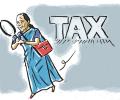
'If you do quick back-of-the-envelope calculation, someone earning Rs 10 lakh can get a benefit of anywhere between Rs 35,000 and Rs 45,000, even if s/he is availing exemptions.' 'A large proportion of people do not avail full exemptions as they don't have money to invest in those schemes.'
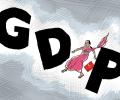
'There are some encouraging signs.' 'Notice that we have not said 7%-plus, we are keeping it at 6% to 6.5%.'
The panel may include or seek inputs from former RBI Governor Urjit Patel, former chief economic advisor Arvind Subramanian, Sajjid Chinoy of the PM-EAC, Rathin Roy, among others.
The ministry said it was an anti-abuse provision amid growing instances of NRIs shifting their stay in low or no-tax jurisdiction to avoid tax payment in India.

This is due to the newly formed Union Territories of Jammu and Kashmir, and Ladakh, which will get funds from the Centre's share, which means devolution will be for 28 states compared to 29 earlier.
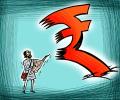
Any reduction in devolution could aggravate the strained relations between the Centre and some opposition-ruled states on a number of issues, including CAA.
 © 2025 Rediff.com - Investor Information - Advertise with us - Disclaimer - Privacy Policy - Sitemap - Feedback - About us - Terms of use - Grievances